The Kinematics of Fit: Why Earhooks Matter for Athletes
Update on Jan. 2, 2026, 8:26 a.m.
In the world of sports audio, gravity is the enemy. Every stride of a runner, every jump of a CrossFitter, and every pedal stroke of a cyclist generates vertical and lateral forces. These forces act on everything attached to the athlete’s body, including their earbuds. For the casual listener, a loose earbud is an annoyance. For the athlete, it is a disruption of flow, a break in concentration, and a potential safety hazard.
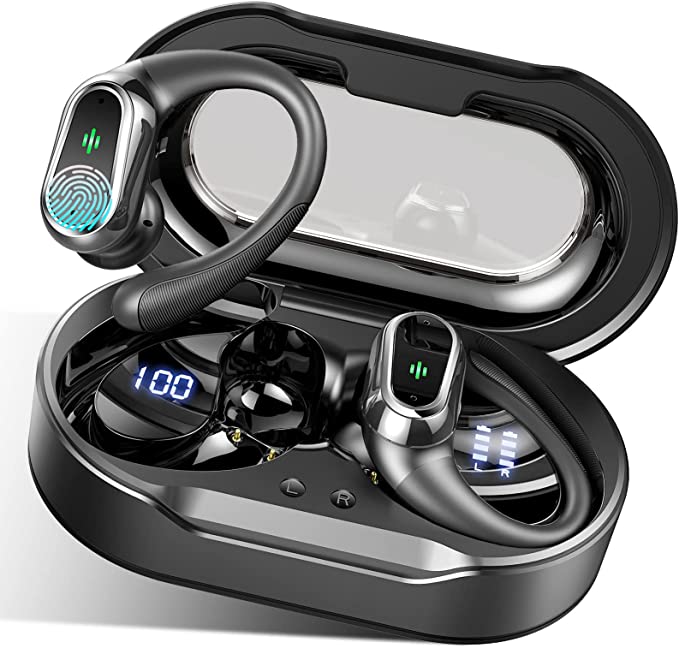
The Qecnato T12, with its distinctive over-ear hook design, addresses this fundamental problem not through software, but through Mechanical Engineering. It acknowledges that the human ear is a complex, variable topography and that relying solely on friction (as standard earbuds do) is insufficient for high-impact activities. This article explores the kinematics of fit, the physics of retention, and why the earhook remains the gold standard for athletic ergonomics.
The Physics of Retention: Friction vs. Leverage
Standard “True Wireless Stereo” (TWS) earbuds rely primarily on Friction Fit. They jam a silicone tip into the ear canal and rely on the elasticity of the tragus and antitragus (parts of the outer ear) to hold them in place. * The Failure Mode: Sweat acts as a lubricant. As the coefficient of friction drops, the gravitational pull and the inertial forces of movement eventually overcome the retention force. The seal breaks, bass response vanishes, and the bud falls out.
The Cantilever Principle
The T12 employs a different mechanism: Leverage. The earhook acts as a cantilever beam that wraps around the helix (the outer rim) of the ear. * Load Distribution: Instead of the ear canal bearing 100% of the device’s weight and inertial load, the hook transfers the majority of these forces to the top of the ear connection point. This is a much larger, more stable structural anchor. * The Fulcrum: Even if the ear tip slips slightly due to sweat, the hook prevents the device from ejecting. The ear acts as a fulcrum, and the hook provides a counter-moment that keeps the speaker driver aligned with the canal.
Kinematics of Movement: Inertia and Momentum
When a runner strikes the ground, they experience a deceleration force of up to 3G (three times their body weight). Their body stops, but loose objects attached to them want to keep moving (Newton’s First Law). * Vertical Oscillation: Earbuds experience this as a violent downward jerk with every step. A standard bud relies on the “interference fit” of the tip to resist this. * The Hook Solution: The over-ear hook mechanically interlocks with the anatomy. For the earbud to fall out, it would have to move up and over the ear, a vector of movement that is highly unlikely during running or jumping. This geometric lock renders vertical inertia irrelevant.
Ergonomics and Long-Term Comfort
Stability often comes at the cost of comfort (e.g., clamping force in headphones). However, the earhook design decouples Retention from Compression. * Zero-Pressure Fit: Because the hook handles the weight, the ear tip doesn’t need to be jammed deep into the canal to stay put. It can sit gently, creating a seal for audio without expanding the canal painfully. This reduces “ear fatigue” and the sensation of occlusion (the “underwater” feeling) often associated with tight-sealing sports buds. * Material Science: Modern hooks (likely silicone or TPE on the T12) are designed with a specific Shore Hardness. They must be rigid enough to hold their shape but soft enough to prevent pressure points on the sensitive skin behind the ear.
Conclusion: Form Follows Function
The design of the Qecnato T12 is a triumph of function over pure minimalism. In an era where earbuds are shrinking to invisibility, the T12 unapologetically occupies space because physics demands it.
For the athlete, this trade-off is essential. The confidence that gear will stay in place allows for full immersion in the activity. It transforms the earbud from a piece of fragile electronics into a piece of reliable athletic equipment, subject to the same biomechanical rigor as a running shoe.