The Swimmer’s Paradox: Why Bluetooth Fails and Bone Conduction Thrives Underwater
Update on Jan. 2, 2026, 8:15 a.m.
Swimming is the most solitary of sports. Unlike the runner who has the city, or the cyclist who has the road, the swimmer has only the black line at the bottom of the pool and the rhythmic rush of water. For decades, this silence was absolute. While other athletes enjoyed the motivation of music, swimmers were cut off by a formidable barrier: Water.
The IFECCO X5 Bone Conduction Headphones are designed to breach this barrier. But for many new users, they bring confusion. “Why does my music cut out when I dive?” “Why do I need to load MP3s in 2025?”
These are not product flaws; they are physics lessons. The X5 is not just a pair of headphones; it is an Amphibious Audio System. To use it effectively, one must understand how sound and radio waves behave differently in air versus water. This article deconstructs the science of underwater audio, explaining why Bluetooth drowns, why bone conduction sings, and how the X5 engineers a solution to the swimmer’s paradox.
Stratum I: The Faraday Cage of the Pool (Bluetooth Physics)
The most common complaint in reviews for swimming headphones is: “Bluetooth disconnects underwater.” This reveals a fundamental misunderstanding of radio physics.
The Resonance of Water Molecules
Bluetooth operates at 2.4 GHz. This frequency is specific. It is very close to the resonant frequency of water molecules. This is why microwave ovens also operate at 2.45 GHz—because that frequency is incredibly efficient at vibrating water molecules to create heat.
When a Bluetooth signal hits water, it doesn’t travel through; it is Absorbed. The energy of the radio wave is converted into microscopic heat in the water.
* Attenuation: In air, Bluetooth can travel 30 feet. In water, it can barely travel 3 inches.
As soon as your head (and the receiver) goes below the surface, the signal from your phone on the pool deck is obliterated. This is a law of physics, not a limitation of the IFECCO X5. No firmware update can change the molecular structure of water.
The Solution: Local Storage
Because the “stream” cannot penetrate the water, the source must go with you.
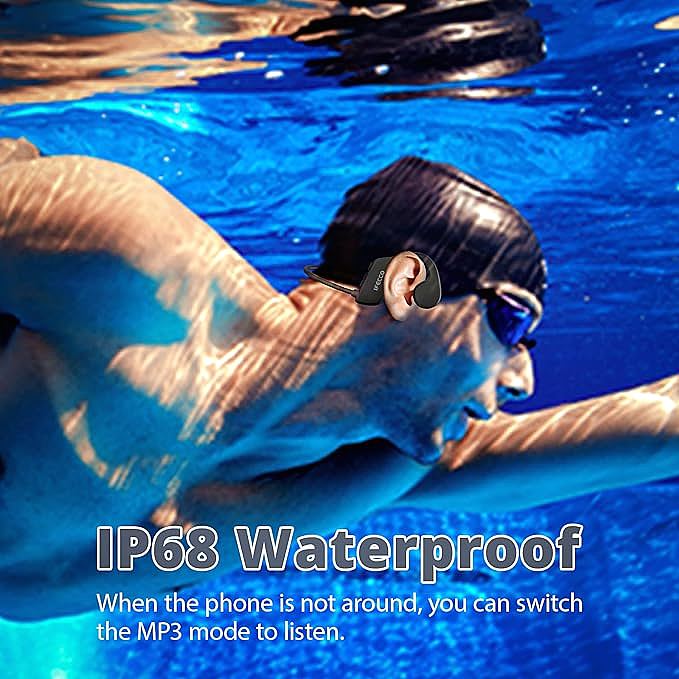
The X5 features 32GB of Built-in Memory. This effectively turns the headphones into a waterproof MP3 player. By storing the files locally on the device’s motherboard, the signal path is reduced from “Phone to Headphone” (wireless) to “Chip to Driver” (wired internally).
This forces a return to the “Old School” method of drag-and-drop file management. While less convenient than Spotify, it is the only way to guarantee uninterrupted audio underwater. It represents a victory of Pragmatism over convenience.
Stratum II: The Acoustic Interface (Bone Conduction in Water)
If water blocks radio waves, how does it affect sound waves?
In air, bone conduction is often criticized for lacking bass and fidelity compared to air conduction (traditional speakers). However, in water, the tables turn.
Impedance Matching
Sound travels by vibrating particles. It moves differently through different densities. * Air Conduction: Sound travels from a speaker (solid) to air (gas) to your eardrum (solid). There is a massive mismatch in density (impedance). Much energy is lost. * Underwater: The water plugs your ear canal. Air conduction drivers struggle because the water adds mass to the eardrum, dampening its movement. * Bone Conduction: The transducer vibrates your skull (solid). Sound travels directly to the cochlea (fluid-filled bone).
Here is the twist: Water is a better conductor of sound than air. It is denser. When you submerge the X5, the water surrounding the transducer and your head actually helps couple the vibration to your skull.
Furthermore, the X5 includes Swimming Earplugs.
Putting in earplugs blocks the noise of splashing water (air/water conduction noise). This isolation creates a quiet chamber where the bone conduction signal—coming from inside your head—becomes dominant. The bass feels richer and the sound clearer underwater than it does on land. The water becomes part of the acoustic transmission chain.

Stratum III: Engineering for Pressure (IP68)
The “IP68” rating on the X5 is not a marketing buzzword; it is an industrial standard. * 6: Dust-tight. * 8: Protected against the effects of continuous immersion in water beyond 1 meter.
The Corrosion Challenge
Swimming pools are chemical baths (chlorine). Oceans are electrolytes (salt). Both eat electronics.
The X5 uses Magnetic Charging. Traditional USB ports have cavities that trap water and corrode contacts. Magnetic pogo-pins are flat and easy to wipe dry.
The internal circuitry is likely potted or coated with a thick Conformal Coating—a chemical layer that seals the PCB from moisture even if the outer plastic shell is breached. This design is what allows the device to survive the hydrostatic pressure of swimming laps or diving shallowly.
Stratum IV: The Dual Identity
The IFECCO X5 is two devices in one chassis.
1. On Land: It is a Bluetooth 5.3 headset. It connects to your phone for calls and streaming. The open-ear design provides safety for runners.
2. In Water: It is an MP3 player. It disconnects from the world and becomes a solitary music box.
This duality requires the user to understand the “Mode Switch” (usually a double-tap). It is a cognitive shift. You leave your phone (and the internet) in the locker. You enter the water with only your music.
In an age of hyper-connectivity, this forced disconnection is a feature. The physics of water creates a digital sanctuary where no notifications can reach you—only the music you consciously chose to bring.
Conclusion: The Bridge Between Worlds
The IFECCO X5 succeeds because it respects the laws of physics. It doesn’t promise Bluetooth where Bluetooth cannot go. Instead, it provides the necessary hardware (storage) to bypass the limitation.
By combining the unique acoustic properties of bone conduction with a rugged, amphibious design, it offers the swimmer what the runner has always had: Rhythm. It turns the pool from a place of silence into a place of sound.