How Variable Speed Belt Geometry Transforms Pipe and Tube Sanding Results

Metabo 7-Inch Variable Speed Pipe/Tube Sander Kit, RBE 15-180 Set, 602243620
Every fabricator who has wrestled with a pipe sander knows the frustration: one pass leaves a uniform satin sheen, the next produces a band of heat intensity per unit-tinted discoloration that no amount of rework can fully erase. The gap between these outcomes is not luck or experience alone. It is physics, and it lives inside three variables that most operators never think about consciously: belt speed, contact geometry, and the mechanical relationship between them.
Understanding how these factors interact on cylindrical workpieces changes pipe sanding from a trial-and-error craft into a repeatable engineering process. This article examines the mechanical principles behind variable speed pipe and tube sanders, with particular attention to how belt wrap geometry, speed regulation, and abrasive selection combine to determine surface quality on metal tubing.
The Cylindrical Problem: Why Pipes Defeat Flat-Surface Logic
Most sanding knowledge comes from flat-surface experience. On a flat workpiece, the contact area between belt and material is a narrow strip whose width depends on belt tension and platen hardness. The math is straightforward: more pressure means more contact, more contact means faster material removal, and the operator can see the entire contact zone at once.
Cylindrical workpieces break this model. When a sanding belt wraps around a pipe, the contact zone becomes an arc whose length depends on the wrap angle. A belt that contacts only 90 degrees of a 4-inch pipe covers roughly 3.14 inches of surface. Increase that wrap to 270 degrees, and the contact length jumps to 9.42 inches, tripling the abrasive surface engaged at any moment.
This geometric reality has cascading consequences. More contact area distributes the same motor power over a larger surface, reducing heat intensity per unit unit area. It also means the abrasive grains experience a longer dwell time per revolution of the belt, which affects both cutting efficiency and belt wear patterns. On a flat sander, a grain touches the work for milliseconds. On a 270-degree wrap around a pipe, that same grain remains in contact for a substantially longer portion of each belt revolution.
The implication is counterintuitive: on cylindrical work, a larger contact area can produce a cooler cut than a smaller one, even at the same belt speed and motor power. This is one reason dedicated pipe sanders with wide wrap angles outperform adapted flat sanders on tubing, even when the flat sander has higher nominal power.
Belt Speed on Curves: The SFPM Calculation and Its Hidden Complexity
Surface Feet Per Minute remains the governing metric for abrasive cutting speed. The standard formula, SFPM = (pi x D x RPM) / 12, where D is the drive wheel diameter in inches, works correctly for flat-belt machines where the belt speed at the contact point equals the belt speed at the drive wheel.
On a pipe sander with wrap-around geometry, a subtlety enters. The belt's inner surface, the one contacting the pipe, travels at a slightly different effective speed than the belt's outer surface over the contact wheels. This differential is small for thin belts on large-diameter pipes, but it becomes measurable on small-diameter tubing with thick abrasive belts. The inner surface compresses around the curve while the outer surface stretches, creating a microscopic speed gradient across the belt thickness.
For practical purposes, this gradient does not change the SFPM calculation, but it does affect belt wear. The inner edge of a belt wrapping a tight-radius pipe experiences more compressive stress than the outer edge, which is why belts on pipe sanders tend to develop tracking drift and edge wear over time. Operators who understand this mechanism can compensate by rotating the belt periodically and avoiding excessive tension that amplifies the differential stress.
The speed range of a variable speed pipe sander like the Metabo RBE 15-180, spanning 1,650 to 5,500 feet per minute, covers the full spectrum of material requirements. Stainless steel demands the lower portion of this range, typically 1,650 to 3,000 SFPM, because its poor thermal conductivity causes friction heat intensity per unit to concentrate at the contact point. Aluminum and softer alloys can tolerate the upper range, 4,500 to 5,500 SFPM, where higher cutting speed improves material removal without the same heat intensity per unit risk.
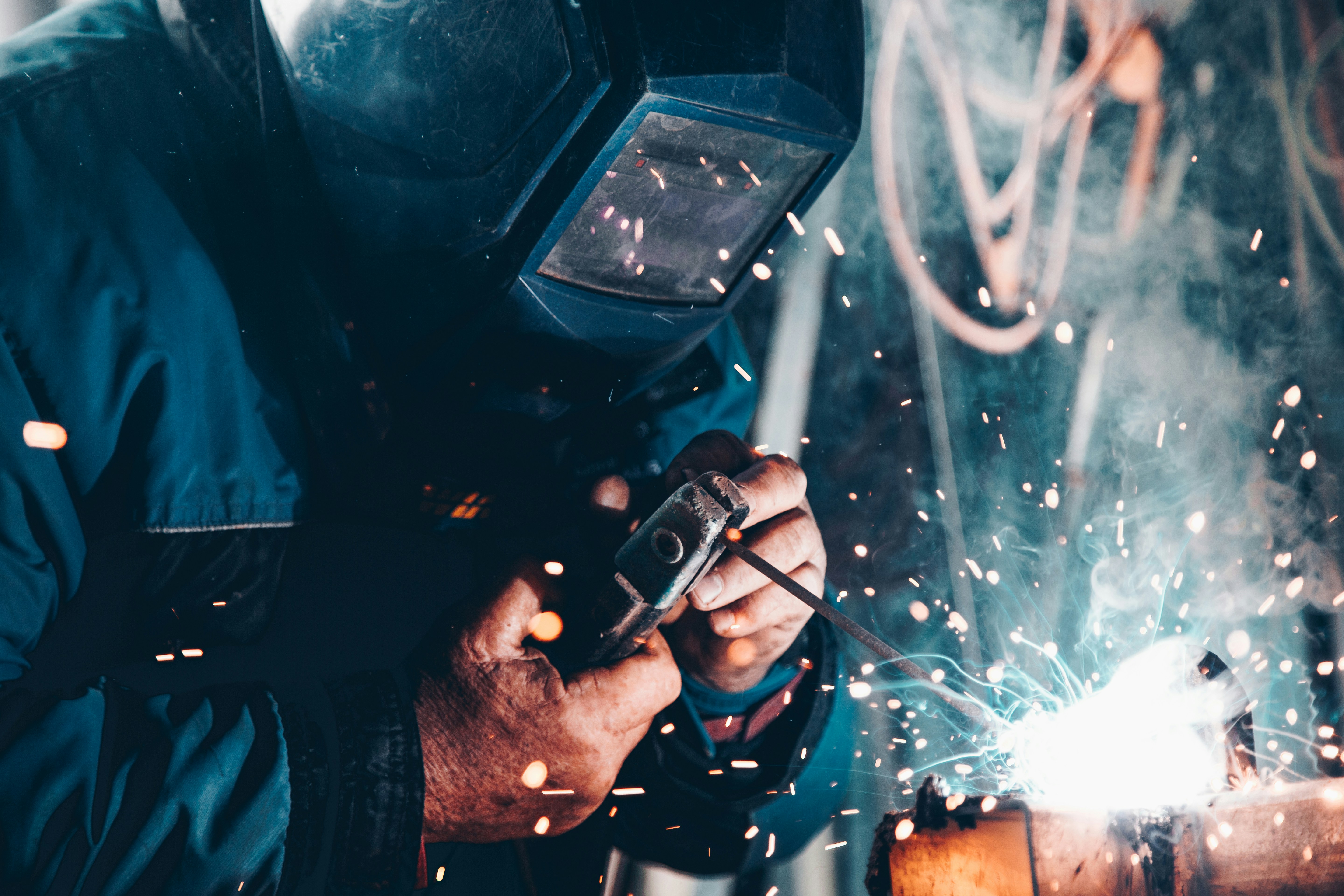
heat intensity per unit Management as a Design Constraint
The thermal behavior of stainless steel under abrasive contact is the single most consequential factor in pipe finishing quality. Stainless steel alloys, particularly the austenitic 300-series grades common in piping, have thermal conductivity values roughly one-quarter to one-third that of carbon steel. heat intensity per unit generated at the sanding contact point cannot flow away from the zone quickly; instead, it accumulates in a shallow surface layer.
At approximately 400 to 500 degrees Fahrenheit, this trapped heat intensity per unit triggers visible oxidation. The color progression, from straw yellow through brown, purple, and blue to black, maps directly to increasing surface temperature and, more critically, to progressive chromium depletion at grain boundaries. Chromium is the element that gives stainless steel its corrosion resistance. When heat drives chromium out of solution to form carbides at grain boundaries, the affected zone becomes susceptible to intergranular corrosion, even if the surface looks polished.
This metallurgical reality imposes a hard constraint on sanding parameters: the surface temperature must remain below the oxidation threshold throughout the entire finishing process. Three variables control this: belt speed, contact pressure, and dwell time. Lower belt speed reduces friction heating. Lighter pressure reduces the normal force that generates friction. Shorter dwell time, achieved by keeping the tool moving along the pipe, prevents heat accumulation at any single point.
Variable speed control addresses the first variable directly. A tool that maintains its set speed under load, rather than bogging down and then surging, delivers consistent friction energy heat intensity per unit time. Electronic speed stabilization systems, such as the Vario-Tacho-Constamatic (VTC) circuitry in professional-grade pipe sanders, use feedback from a tachometer to adjust motor power in real time. When the operator presses harder and the motor begins to slow, the electronics increase power to maintain the target RPM. When the load decreases, power reduces to prevent overspeeding.
This feedback loop eliminates the speed oscillations that create hot spots. On a non-regulated sander, each momentary speed drop reduces cutting efficiency, prompting the operator to press harder, which increases friction, which generates more heat, which the material cannot dissipate. The cycle feeds on itself. Speed regulation breaks the cycle by maintaining consistent cutting conditions regardless of load variation.
Wrap Angle: The Geometric Amplifier
The wrap angle of a pipe sander, the arc of belt contact around the workpiece, is the feature that most clearly distinguishes a dedicated pipe tool from a general-purpose sander. A 270-degree wrap, as found on the Metabo RBE 15-180, means the belt contacts three-quarters of the pipe circumference simultaneously.
The mechanical advantage is substantial. Compared to a flat-belt contact, which touches only the tangent line at the top of the pipe, a 270-degree wrap increases the engaged abrasive area by a factor of approximately six. This multiplication has three direct effects.
First, material removal rate increases proportionally. More abrasive grains are cutting simultaneously, so each pass removes more material. For a fabricator working through a grit progression from coarse weld removal to fine finishing, this translates to fewer passes per grit level and shorter overall process time.
Second, the finish becomes more uniform around the pipe circumference. With a small contact area, the operator must rotate the pipe or the tool to reach every part of the surface, and slight variations in overlap or pressure create visible bands. With a 270-degree wrap, most of the circumference receives simultaneous and equal treatment. The operator only needs to rotate the tool approximately 90 degrees to complete the full 360-degree coverage, and the overlap zone between positions is inherently blended by the wide contact.
Third, heat intensity per unit unit area decreases. The same total friction energy is distributed across six times the surface area, so the local temperature rise at any point on the pipe is correspondingly lower. This thermal benefit is particularly important for stainless steel, where the margin between acceptable process temperature and damaging oxidation is narrow.
The practical limitation of wide-wrap geometry is belt tracking. A belt that wraps 270 degrees around a pipe must remain centered throughout the contact arc. If the operator tilts the tool, the belt shifts toward one edge, concentrating wear and stress on that edge. Over time, this edge wear causes the belt to track progressively worse, eventually leading to belt breakage. The corrective technique is straightforward: maintain the tool perpendicular to the pipe axis, and monitor the belt tracking indicator, typically a colored stripe near one edge of the belt, to ensure it remains centered on the contact wheel.

Abrasive Engineering: From Random Grit to Structured Media
The abrasive belt itself is an engineered component whose design profoundly affects finishing outcomes. Conventional abrasive belts use mineral grains, aluminum oxide, zirconia alumina, or ceramic, bonded to a flexible backing in a random distribution. The random pattern means that some areas of the belt have dense grain coverage while others have gaps, and the grain height varies across the surface.
Structured abrasive belts, often called pyramid belts, take a different approach. The abrasive mineral is formed into precisely shaped three-dimensional pyramids arranged in a regular pattern across the belt surface. Each pyramid has the same size, shape, and mineral content, and the pyramids are spaced at uniform intervals.
The performance difference arises from how the two types wear. A random-grit belt wears unevenly: the tallest grains do most of the cutting and wear down first, while shorter grains remain inactive. As the tall grains dull, cutting efficiency drops, and the operator must increase pressure to maintain material removal. This increased pressure generates more heat and creates a less consistent scratch pattern.
A pyramid belt wears progressively. As the tip of each pyramid wears away, it exposes a fresh layer of sharp mineral at a slightly larger cross-section. The cutting action remains consistent throughout the belt's life because fresh abrasive is continuously revealed. The scratch pattern stays uniform because every pyramid produces the same scratch geometry, and the regular spacing ensures even coverage without the gaps that characterize worn random-grit belts.
For pipe sanding, where the contact geometry already provides uniform pressure distribution through the wrap angle, pyramid belts complement the mechanical advantage. The combination of geometric uniformity from the wrap and abrasive uniformity from the structured media produces finishes with minimal variation around the pipe circumference, a result that is difficult to achieve with random-grit belts even at high skill levels.
The grit progression for pipe finishing follows a sequence that reflects the scratch-depth relationship between successive grades. Starting from weld removal at P80, which leaves scratches approximately 180 microns deep, each subsequent grit reduces the scratch depth by roughly 60 to 70 percent. P280 brings the surface to approximately 60 microns, P400 to 40 microns, P600 to 25 microns, and P1200 to 15 microns. A final pass with a non-woven fleece pad blends the remaining micro-scratches into a uniform satin or near-mirror finish.
The critical rule, documented by Wagner Companies and confirmed across multiple industry sources, is that grit levels must not be skipped when moving backward to a coarser grade. If a fine-grit pass reveals deep scratches that require returning to a coarser abrasive, the operator should step back only one grit level at a time. Skipping multiple levels leaves a mismatch between the scratch depth the coarse grit produces and the depth the fine grit can remove, resulting in a surface that appears finished under casual inspection but shows ghost scratches under angled light.
Cross-Contamination: The Invisible Enemy
A factor that receives less attention than speed and grit, but can undermine weeks of careful finishing work, is iron cross-contamination. When carbon steel particles, from grinding dust in the shop air, from shared abrasive belts, or from contact with carbon steel tools, embed in a stainless steel surface, they create microscopic galvanic cells. The iron particles act as anodes relative to the surrounding stainless matrix, and in the presence of moisture, they corrode rapidly, producing rust spots that penetrate the protective chromium oxide layer.
The prevention protocol is systematic. Dedicated abrasive belts and contact wheels for stainless steel work, stored separately from carbon steel supplies. Clean work surfaces and pipe supports before beginning a stainless project. Avoid using the same shop ventilation system that handles carbon steel grinding dust without adequate filtration. For critical applications, such as food-grade or pharmaceutical piping, a ferroxyl test after finishing can confirm the absence of embedded iron contamination.
This discipline is not merely cosmetic. In sanitary piping applications, rust spots from iron contamination become bacterial colonization sites, defeating the hygienic purpose of the stainless steel specification. In marine and chemical processing environments, localized corrosion at contamination sites can initiate pitting that propagates under the surface, eventually causing through-wall penetration even when the surrounding metal remains fully resistant.
Motor Design and Sustained Performance
Pipe sanding is a sustained-load application. Unlike intermittent grinding, where the motor cools between bursts, a pipe sander running a long pass on a 20-foot length of tubing operates under continuous load for minutes at a time. This duty cycle demands a motor with sufficient thermal margin to maintain full power output without progressive derating.
The 13.5-amp, 1,550-watt motor specification of professional pipe sanders reflects this requirement. At full load, the motor draws near its rated current continuously, and the thermal protection must be designed to allow this sustained operation without nuisance tripping. Consumer-grade tools with lower power ratings often protect their motors by limiting duty cycle, which forces the operator to pause frequently, interrupting the finishing rhythm and creating inconsistency at the restart points.
Motor torque characteristics also matter. A high-torque motor maintains cutting speed when the abrasive encounters a hard spot, such as a weld heat-affected zone where the local hardness may be 20 to 30 percent higher than the base metal. A low-torque motor slows at these points, reducing SFPM and cutting efficiency, which prompts the operator to press harder, which increases heat, which compounds the problem. The combination of high torque and electronic speed regulation ensures that the belt speed remains within the target SFPM range regardless of local hardness variations in the workpiece.
Putting the Variables Together: A Process Framework
The interaction of belt speed, wrap geometry, abrasive type, and heat management creates a multi-variable process that can be optimized systematically rather than approached by trial and error. The framework follows a decision sequence.
First, identify the material. Stainless steel sets the speed ceiling at 3,000 SFPM and demands careful heat monitoring. Aluminum allows speeds up to 5,500 SFPM with less thermal concern. Carbon steel occupies the middle ground.
Second, determine the starting surface condition. A fresh weld requires beginning at P80 with zirconia or ceramic belts for aggressive stock removal. A pre-finished surface needing only refinement can start at P400 or finer.
Third, set the belt speed to the appropriate SFPM range for the grit level. Coarse grits operating at lower speeds within the material's range provide controlled material removal with manageable heat generation. Finer grits can operate at slightly higher speeds because they remove less material per pass and generate less total friction energy.
Fourth, execute the grit progression without skipping levels. Each step exists to refine the scratch pattern from the previous step, and the mathematical relationship between successive grit sizes ensures that each abrasive can fully remove the predecessor's marks.
Fifth, verify the finish under angled light before declaring completion. A surface that looks uniform under overhead lighting may reveal directional scratches, banding, or residual heat tint when illuminated at 45 degrees from the surface. This inspection step catches problems while the appropriate grit is still on the tool, rather than discovering them after a final pass that cannot correct them.
The science of pipe and tube sanding is not abstract theory. It is the practical knowledge that transforms a variable speed belt sander from a blunt instrument into a precision finishing tool. When belt speed matches the material's thermal limits, when wrap geometry maximizes contact uniformity, when abrasive engineering provides consistent cutting action, and when the operator understands why each parameter matters, the result is a surface finish that meets specification on the first attempt, every attempt.
Metabo 7-Inch Variable Speed Pipe/Tube Sander Kit, RBE 15-180 Set, 602243620
Related Essays

What is a Galvo Fiber Laser? The Tech Behind 10,000 mm/s Metal Etching
What is a Galvo Fiber Laser? The Tech Behind 10,000 mm/s Metal Etching

Understanding Galvo Laser Scanners: How Mirror Deflection Enables High-Speed

How 3300 PSI Hydraulic Pumps Turn Liquid Paint Into Atomized Coating: Inside the Titan Impact 440

How Three-Phase Oscillating Edge Sanders Eliminate Finish Defects in Production Woodworking
