Bone Conduction Headphones for Swimming: The Complete Guide

IFECCO X5 Bone Conduction Headphones
The Unheard Symphony: From Beethoven's Jaw to Modern Audio
The world was dissolving into silence for Ludwig van Beethoven. By his late forties, the composer who had poured his soul into symphonies could barely hear the orchestras performing his own masterpieces. In the desperate quiet of his losing hearing, he discovered an effective approach: if he clamped a metal rod between his teeth and pressed the other end against his piano's soundboard, vibrations traveled through his jawbone directly to his inner ear. He was not hearing through his eardrums at all. He was feeling sound through bone. Two centuries later, that same principle powers a new category of bone conduction headphones swimming athletes rely on to keep their playlists going beneath the surface of a pool.
To understand why this matters, we first need to rethink how hearing works. Most of us imagine sound traveling the way it does in a recording studio: waves move through air, enter the ear canal, vibrate the eardrum, and pass through a chain of tiny bones to the cochlea, a spiral-shaped organ filled with fluid and microscopic hair cells. Those hair cells convert mechanical energy into electrical impulses that the brain interprets as music, speech, or the hum of a refrigerator. It is an elegant system, but it is not the only one.
Bone conduction takes a shortcut. Instead of routing sound through the ear canal and eardrum, vibrations are applied directly to the bones of the skull—typically the cheekbones just in front of the ears. These vibrations travel through the solid structure of the skull, arrive at the cochlea from the inside, and stimulate the same hair cells. The brain receives identical electrical signals. The difference is the pathway, and that difference changes everything about how we experience sound in the real world.
How Bone Conduction Transfers Sound Through Your Skull
The heart of any bone conduction device is a piezoelectric transducer—a small component that converts electrical signals into precise mechanical vibrations. When you play music through bone conduction headphones, the transducer presses against your temporal bone or cheekbone and sends controlled oscillations directly into the skull. These vibrations ripple through the dense cranial structure and reach the fluid-filled cochlea, where specialized hair cells detect the movement and translate it into neural signals.
This direct pathway has consequences for sound quality. Air conduction through the ear canal provides a natural amplification effect—the outer ear acts like a funnel, collecting sound waves and directing them toward the eardrum. Bone conduction bypasses this amplification entirely. The result is a sound signature that emphasizes the midrange frequencies (roughly 1 kHz to 4 kHz, the range where human speech lives) while sacrificing low-frequency bass response. You will hear vocals and instruments clearly, but the deep rumble of a kick drum will feel muted.
For swimming, this trade-off is irrelevant. Underwater, air conduction simply does not work. Sound waves traveling through water enter the ear canal but find nothing to vibrate against—the water pressure equalizes on both sides of the eardrum, canceling the pressure differential that drives traditional hearing. Bone conduction sidesteps this problem entirely. Vibrations transmitted through the skull do not depend on air pressure differences. They work just as well submerged at one meter as they do in air. This is why **bone conduction headphones swimming enthusiasts consider this technology the only viable wireless audio option for lap swimming, making bone conduction headphones swimming the preferred choice for serious athletes.
The frequency range of bone-conducted sound is narrower than air-conducted sound—typically 50 Hz to 6 kHz compared to 20 Hz to 20 kHz for healthy air conduction. But for the purpose of enjoying music, podcasts, and audiobooks during a workout, the reduced bandwidth is acceptable. The brain fills in gaps remarkably well, especially with familiar content.
Why Swimmers Need Open-Ear Audio Solutions

Swimming is one of the few mainstream sports where audio was completely impossible until recently. Traditional headphones—earbuds, in-ears, even most over-ear designs—fail in the pool for multiple reasons. Earbuds fall out during flip turns. Over-ear headphones cannot be secured under a swim cap. Neither class of device is rated for submersion, and water damage voids warranties on almost all consumer electronics.
Beyond the practical issues, there is a safety consideration. Swimmers who wear traditional earbuds lose their ability to hear pool-side warnings, lane officials, or other swimmers calling out. In a crowded pool, spatial awareness matters. Open-ear audio leaves the ear canal completely exposed, allowing ambient sound to mix with your playlist at whatever volume you choose.
Hygiene is another factor. Keeping earbuds in your ears for extended periods traps moisture and heat in the ear canal, creating an environment where bacteria and fungi thrive. Pool water introduces additional contaminants. For swimmers who train daily, open-ear designs eliminate the risk of otitis externa—commonly known as swimmer's ear—associated with prolonged earbud use in chlorinated environments.
Water resistance ratings determine whether a device can survive actual swimming. An IPX7 rating means the device can withstand immersion in one meter of water for thirty minutes. An IP68 rating goes further: it guarantees complete dust protection and submersibility to depths typically specified by the manufacturer—often up to 30 meters for sports headphones. For serious lap swimmers, IP68 is not a luxury; it is the minimum specification. This is why choosing the right bone conduction headphones swimming options requires understanding both the technology and the specific demands of aquatic sports.
IFECCO X5: Engineering a Waterproof Bone Conductor
This device represents one of the most aggressive attempts to build a truly waterproof bone conduction device for the consumer market. Priced at approximately $47.83—roughly 40 percent below premium competitors like Shokz—the X5 targets a gap in the market that has historically been underserved: affordable, genuinely swim-ready audio equipment.
The IP68 rating on the X5 is not marketing language. For anyone searching for reliable bone conduction headphones swimming enthusiasts swear by, this specification separates devices that merely survive splashes from those built for serious lap training. The device has been independently tested for submersibility to 30 meters, making it suitable for competitive lap swimming, open-water training, and even shallow diving. The sealing design eliminates the speaker grilles and ports that typically allow water ingress in conventional headphones. Every circuit board and battery compartment is encased in a waterproof housing with silicone gaskets at all connection points.
The 32 gigabytes of built-in storage is the X5's most distinctive feature for swimmers. Standard Bluetooth 5.3 headphones can stream audio from a phone left on the pool deck, but Bluetooth radio waves attenuate rapidly in water—the signal effectively dies within centimeters of the surface. This is a fundamental physics limitation, not a design flaw. To listen to music underwater, you need audio stored locally on the device. The X5's 32 GB holds approximately 10,000 compressed audio files, enough for months of varied listening without touching your phone.
The device supports dual-mode operation. In Bluetooth mode, it pairs with smartphones, tablets, and smartwatches for wireless streaming on land. In MP3 mode, it reads directly from a microSD card or accesses its internal storage for offline playback. Switching between modes is handled through physical buttons on the right transducer housing—a deliberate choice, since touch controls fail when wet.
At 30 grams, the X5 is exceptionally lightweight. The frame uses a titanium alloy bending arm that provides flexibility for different head sizes while maintaining structural integrity through thousands of flex cycles. The transducer housings are molded from ABS plastic, which is durable, water-resistant, and easy to clean after exposure to chlorinated or salt water.
Real-World Performance: Sound Quality and Fit
With a 3.8 out of 5 star rating across 365 global reviews, the IFECCO X5 occupies a pragmatic position in the bone conduction headphone market. Its sound quality scores 4.0 out of 5 within the category, which means it performs well relative to other bone conduction devices—not that it matches the fidelity of high-end sealed earbuds. This distinction matters. Anyone comparing the X5 to $200 wired studio headphones will be disappointed. Anyone evaluating it as a swim workout companion will likely find the audio perfectly serviceable.
The open-ear design delivers on its promise: you hear your music vibrating through your cheekbones while simultaneously hearing everything happening around you. In a pool environment, this means you can enjoy your playlist while remaining aware of lane markers, other swimmers, and pool-side announcements. On a morning run, it means you can hear approaching cyclists and traffic without removing a single earpiece.
Fit is the most commonly cited concern in user reviews. The X5's headband is designed to accommodate average to large adult head sizes. Users with smaller heads sometimes report that the transducers do not maintain consistent contact with the cheekbones, which reduces sound quality and causes audio leakage. The solution often involves wearing a swim cap to hold the transducers in place—a workaround that is inconvenient but effective.
One detail worth noting: the X5 ships with a pair of silicone earplugs. These serve a dual purpose. During swimming, they reduce hydrodynamic noise (the sound of water rushing past the ear canal), which allows the brain to focus more clearly on the bone-conducted audio signal. Many reviewers report that using the earplugs significantly improves perceived sound quality underwater, even though the music is not traveling through the ear canal at all.
The button layout deserves mention for its counterintuitive design. To skip tracks, pressing and holding the volume-up button moves backward in your playlist, while pressing and holding the volume-down button moves forward. This reverses the logical mapping that most consumers expect from electronic devices. New users typically spend ten to fifteen minutes figuring out the pattern. Once learned, it becomes automatic, but it is worth knowing going in.
Using Bone Conduction Headphones Underwater
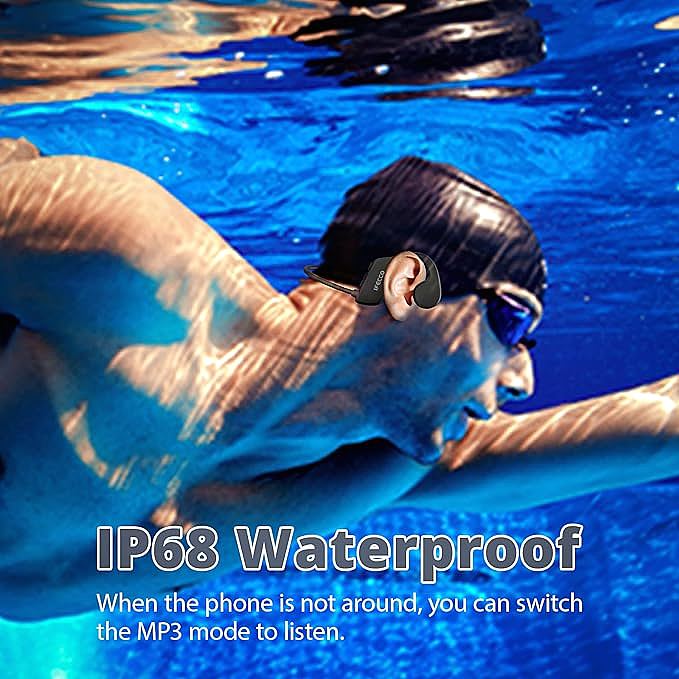
Getting the best experience from bone conduction headphones in a pool requires a specific routine. Here is the process most experienced users follow:
Step 1: Pre-swim setup. Pair the device with your phone via Bluetooth 5.3. Load your playlist onto the 32 GB storage or insert a microSD card with your music. Ensure the battery is charged—full charge takes approximately two hours using the included magnetic charging cable.
Step 2: Mode selection. Before entering the water, switch the device from Bluetooth streaming mode to MP3 playback mode. This is done by pressing and holding the designated mode button until the device confirms the switch. The Bluetooth connection will remain active on the pool deck, but it will not transmit audio once submerged.
Step 3: Fit adjustment. Position the transducers on your upper cheekbones, approximately one finger-width in front of your ear canal. They should rest firmly against the bone without causing discomfort. If you are wearing a swim cap, slide the transducers under the cap material for additional pressure and stability.
Step 4: Insert earplugs (optional). Place the included silicone earplugs in your ear canals. This is not required for the device to function, but it reduces ambient pool noise and improves the clarity of the bone-conducted signal.
Step 5: Depth awareness. Sound quality remains consistent at shallow depths (0.5 to 1 meter). As you increase depth beyond two meters, water pressure against the skull begins to dampen vibration transmission slightly. For typical lap swimming, this effect is negligible. Understanding these nuances is what separates effective bone conduction headphones swimming routines from frustrating experiences that end with a broken device and a wasted investment. For deep-water training or diving, the reduction in perceived volume may be noticeable.
Battery life varies by mode. In Bluetooth streaming mode, expect six to eight hours of continuous playback. In MP3 mode with the built-in storage, the X5 typically delivers eight to ten hours. The magnetic charging interface is robust and has been tested for thousands of connect-disconnect cycles, though users should ensure the charging contacts remain dry and free of chlorine residue to maintain reliable connections.
Beyond Swimming: Where Bone Conduction Excels
While this device is specifically engineered for swimming, bone conduction technology serves a broader range of applications that extend well beyond the pool.
For runners and cyclists, the primary advantage is environmental awareness. Traditional earbuds create an acoustic seal that blocks ambient sound. Even at moderate volumes, this isolation can be dangerous near traffic. Bone conduction headphones deliver audio directly to the inner ear while leaving the ear canal open, allowing you to hear car horns, bicycle bells, pedestrians, and other environmental cues without adjusting volume or removing a device.
In tactical and military contexts, bone conduction microphones and headphones have been used for decades. Soldiers operating in noisy environments—helicopter cockpits, armored vehicles, construction zones near combat areas—need clear communication without compromising their ability to hear commands and threats. The open-ear design combined with a chest- or jaw-mounted microphone provides exactly that capability.
Medical applications are perhaps the most impactful. People with conductive hearing loss—damage to the outer or middle ear that prevents sound from reaching the cochlea—can sometimes bypass the damaged structures entirely using bone conduction. Bone-anchored hearing aids (BAHA) are FDA-approved medical devices that surgically mount a transducer to the skull. Consumer bone conduction headphones offer a non-invasive alternative for mild to moderate cases.
When comparing this model to premium competitors in the space, the value proposition becomes clear. Shokz's Aeropex model retails for approximately $130, offers an IP55 rating (splash-resistant but not submersible), and has no built-in storage. The IFECCO X5 costs roughly one-third of that price while delivering IP68 waterproofing and 32 GB of storage. The trade-offs are in build refinement, companion app ecosystem, and customer support infrastructure. But for a swimmer who needs waterproof audio at a reasonable price, the X5 delivers functionality that exceeds its price tier.
The technology continues to evolve, and as more swimmers discover the advantages of bone conduction headphones swimming, the market will likely see even more competition and innovation in this space. Piezoelectric transducer efficiency is improving year over year, narrowing the sound quality gap with traditional drivers. Battery chemistry improvements extend playback times. New sealing techniques allow even greater water resistance without increasing weight. For anyone who has ever wanted to listen to music while swimming—and who previously accepted that it was impossible—the progress in bone conduction headphones swimming technology is genuinely exciting.
IFECCO X5 Bone Conduction Headphones
Related Essays
