Gravity Defied: Engineering Analysis of the BEAMNOVA 1543lb Portable Hoist
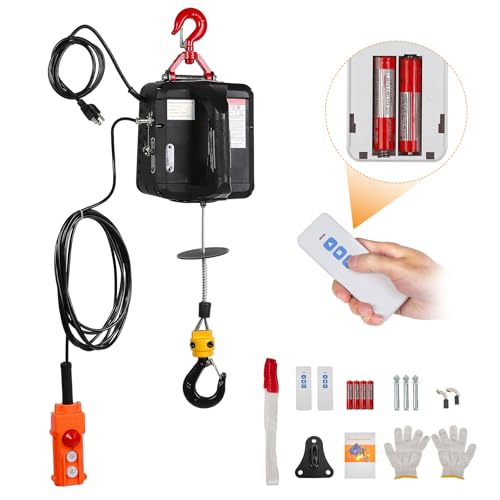
BEAMNOVA 3 in 1 Portable Electric Hoist
In the lexicon of mechanical advantage, the terms "winch" and "hoist" are often used interchangeably by the uninitiated. This linguistic precision matters because physics does not forgive confusion. A winch is designed to pull a rolling load horizontally; a hoist is engineered to lift a dead weight vertically against gravity. The difference lies in the braking mechanism.
The BEAMNOVA 3-in-1 Portable Electric Hoist is a purpose-built vertical lifting machine. Weighing only 22 lbs but capable of lifting 1543 lbs (700kg), it represents a specific class of "micro-industrial" equipment designed to bridge the gap between manual chain blocks and permanent overhead cranes. To understand its utility, we must examine the engineering that prevents a suspended half-ton load from becoming a kinetic projectile.

The Thermodynamics of the Copper Core
The limiting factor of any compact electric lifting device is heat. Lifting a 1500lb load requires a massive surge of current. In cheaper motors using aluminum windings, the internal resistance is higher (Aluminum has roughly 61% the conductivity of Copper). This resistance converts valuable electrical energy into waste heat.
The BEAMNOVA utilizes a Pure Copper Core Motor. * Conductivity: Copper's superior conductivity minimizes $I^2R$ losses (resistive heating). This allows the motor to maintain high torque output without reaching thermal shutdown temperatures as quickly as aluminum counterparts. * Thermal Mass: The aluminum alloy housing acts as a heatsink, conducting the thermal energy generated by the copper stator away from the core. This thermal management is critical for maintaining the Duty Cycle—the amount of time the hoist can run versus resting.
Control Redundancy: The 3-in-1 Logic
In rigging scenarios, the operator's position relative to the load is a critical safety variable. The "3-in-1" designation refers to the control interfaces: Manual, Wired, and Wireless.
From a safety engineering perspective, this is Control Redundancy.
1. Wireless: Utilizing RF (Radio Frequency), this allows the operator to stand outside the "Fall Zone" (the area directly beneath the load) or gain a better vantage point, crucial when lifting bulky objects like HVAC units to a roof.
2. Wired: RF signals can suffer interference. The wired pendant provides a fail-safe, hard-line connection for precise positioning where signal lag is unacceptable.
3. Manual: A direct override on the unit ensures that mechanical control is possible even if remote batteries fail.

The Physics of the Limit Switch
One of the most common failure modes in hoisting is "Two-Blocking" or "Over-winding"—when the hook is pulled all the way into the drum, snapping the cable or burning out the motor.
The BEAMNOVA integrates an electromechanical Limit Switch (Stopper Device). * Mechanism: As the load rises, a physical weight or collar on the wire rope contacts a lever arm on the hoist body before the hook hits the drum. * Action: This lever mechanically breaks the electrical circuit to the "Up" relay. It is a passive safety system that relies on physical contact, ensuring that the motor is cut before mechanical interference occurs. This is a standard requirement in industrial cranes, scaled down for portability.
Rigging Dynamics: Wire Rope and Galvanization
The tensile element is a Galvanized Steel Wire Rope. Unlike synthetic ropes used in recovery winches, hoists prefer steel for its resistance to abrasion against the drum and its static stability. * Galvanization: The zinc coating acts as a sacrificial anode. In outdoor environments, the zinc oxidizes before the steel, preventing the formation of rust deep within the strands which could cause catastrophic failure under load. * Anti-Rotation: The inclusion of a 360-degree swivel hook is not a luxury; it is physics. As wire rope is loaded, it naturally wants to untwist. If the hook cannot rotate, this torque is transferred to the load, causing it to spin dangerously. The swivel bearing decouples this torque, keeping the load stable.

Conclusion: The Portable Solution
The BEAMNOVA 3-in-1 Hoist is not a replacement for a permanent shop crane. It is a tactical tool for dynamic environments. By combining the thermal efficiency of copper, the safety logic of limit switches, and the versatility of multi-mode control, it offers a safe method to defy gravity in places where heavy machinery cannot go.
For the hunter processing game in the field, or the contractor lifting materials to a second story, understanding the difference between a winch and a hoist—and choosing the latter—is the first step in rigging safety.

Mechanical Advantage and Gear Reduction
The fundamental principle behind any hoist is mechanical advantage — the ratio of output force to input force. A portable electric hoist like this unit achieves its 1543 lb rated capacity through a multi-stage gear reduction system. The electric motor spins at several thousand RPM, but the drum rotates at a fraction of that speed. The gear train multiplies torque proportionally to the reduction ratio: a 50:1 reduction means the drum sees 50 times the motor's torque but at 1/50 the speed.
This relationship is governed by the power equation: P = τ × ω. At constant power, torque and rotational speed are inversely related. A hoist that lifts slowly can lift more weight because the gear train has more stages of reduction. The practical tradeoff is lift speed versus capacity — a configuration optimized for 1543 lbs at 10 ft/min uses different gearing than one optimized for 500 lbs at 30 ft/min.
The BEAMNOVA's multiple configurations (single line, double line, and triple line setups) create additional mechanical advantage through block-and-tackle reaving. Running the cable through a pulley block doubles the mechanical advantage but halves the lift speed. This is why the unit can be rated at 1543 lbs in single-line mode — that rating already accounts for the gear reduction internal to the hoist.
Load Rating and Safety Factors
Every lifting device is rated with a safety factor calculated as the ratio of minimum breaking strength to working load limit. Industrial overhead cranes typically use a 5:1 safety factor for wire rope and 4:1 for structural components. Portable hoists in this class generally operate at 4:1 to 5:1, meaning the wire rope can theoretically hold 6000-7700 lbs before failure, but the rated capacity is kept at 1543 lbs to provide margin for dynamic loading, wear, and manufacturing tolerances.
Dynamic loading is the hidden variable that most operators underestimate. A load that is lifted abruptly, swung, or subjected to wind can experience momentary forces 2-3 times its static weight. The safety factor absorbs these transient loads. When the safety factor is consumed by wear — corroded wire rope, bent hooks, worn brake pads — the margin disappears and the risk of catastrophic failure increases nonlinearly.
The galvanized steel wire rope on this hoist is not infinite-life. Each lifting cycle induces microscopic work hardening in the outer wires. Over time, these wires develop fatigue cracks that propagate inward. The industry standard retirement criteria for hoist wire rope is 6 broken wires in one rope lay length, or 3 broken wires in one strand. Visual inspection before each use is the primary defense against fatigue failure.
Braking Systems: The Difference Between Holding and Stopping
A hoist's brake system serves two distinct functions: holding the load stationary when power is off, and stopping the load if it begins to descend uncontrolled. These are engineering different problems requiring different solutions.
The BEAMNOVA uses an electromechanical brake that engages when power is removed. This is a fail-safe design: the brake is spring-loaded to the engaged position, and electromagnetic force from the motor circuit holds it open during operation. If power fails, the spring applies the brake automatically. This is fundamentally different from a winch brake, which typically uses friction to control descent speed rather than to hold position.
The distinction matters because a winch brake allows controlled slippage — useful when lowering a vehicle down a slope. A hoist brake must hold position with zero slippage — because a load suspended above people or equipment cannot be allowed to drift. This is why substituting a winch for a hoist in overhead lifting applications is a safety violation. The braking physics are fundamentally incompatible.