The "60-Hour Playtime" Lie: A 2025 Guide to Earbud Battery Life
Update on Jan. 2, 2026, 9:24 a.m.
You’re shopping for earbuds. You see two boxes. One boasts “30-Hour Playtime.” The other, “60-Hour Playtime.”
It’s a no-brainer, right? The 60-hour pair is clearly twice as good.
You just got tricked.
This isn’t your fault. You’ve just been a victim of a powerful psychological trick called the “Anchoring Bias.”
It’s a concept where our brains latch onto the first piece of information we see (the “anchor”) and use it to make all future judgments. Marketers know this. They put the biggest, most impressive number—“60”—front and center. That “60” becomes your anchor, and everything else seems less important.
But that “60-hour” number is almost certainly not what you think it is.
The Truth About “Total Playtime”
When a brand advertises “60-Hour Playtime,” they are almost never talking about the earbuds themselves.
They are talking about the earbuds + the charging case.
This number is the total time you can get by repeatedly draining the earbuds, putting them back in the case, recharging them, draining them again, and so on, until the case itself is dead.
It’s not a lie. It’s just… marketing.
That number only tells you how long you can go before you need to find a USB-C cable to charge the case. It has nothing to do with how long you can listen to music in one sitting.
The One Number That Actually Matters: “Single-Charge Playtime”
Buried in the fine print, often deep in the “About this item” section, you will find the number that actually matters.
It’s called “Single-Charge Playtime.”
This is the real-world number. This is how long the earbuds themselves will last, from 100% to 0%, in one continuous session.
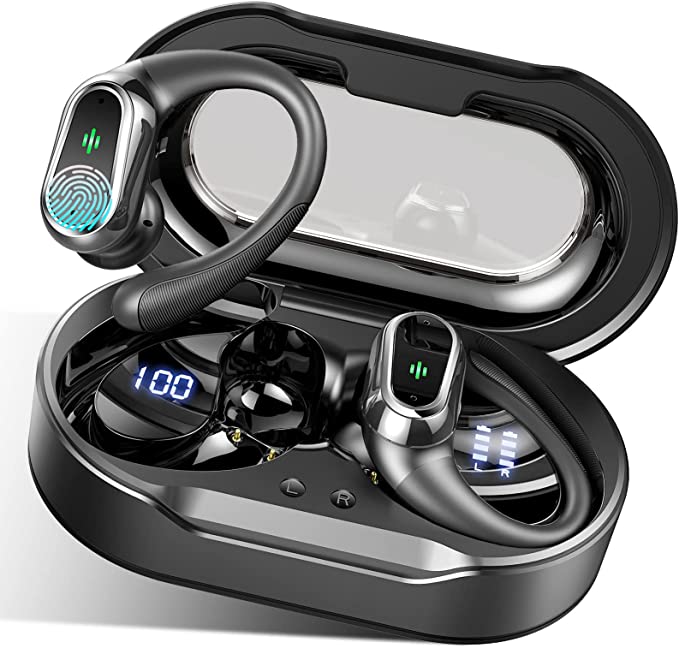
Let’s look at a classic example from a product spec sheet, like one for the Carego Y42 Pro earbuds.
* The “Anchor” (Big Print): 60H Playtime
* The “Real” Number (Fine Print): one earbud can be used for 5hrs on one charge
See? The real battery life for your marathon Zoom call or your long run is 5 hours, not 60. The 60 hours is just the 5 hours from the buds, plus the 55 or so hours of “refills” stored in the case.
5 hours is still a great battery life! But it’s not 60. When you’re comparing a “60-hour” pair (with 5 hours single charge) to a “30-hour” pair (with 8 hours single charge), which one is actually better for your needs? The one with the smaller total number!
One Feature That Fights Back: The LED Display
The one antidote to battery anxiety is transparency.
The worst feeling is seeing a single, blinking dot on your case and having no idea if it means 5% or 30%.
This is why one of the most pro-consumer features to look for is a Dual LED Digital Display.
Instead of vague dots, these cases show you a hard number: “87%”. This feature, seen on cases like the one for the Y42 Pro, is a sign of good design. It respects you as a user. It removes the guesswork and lets you know exactly when you need to charge.
How to Buy Smart (3 Questions to Ask)
Forget the “anchor.” The next time you shop, ignore the giant “total” number and ask yourself these three questions instead:
- What is the single-charge playtime? (Look for this in the fine print.)
- How long is my average listening session? (If you only commute for 45 minutes, any pair with 3+ hours is fine. If you work 8-hour shifts, you need 8+ hours or the ability to use one bud at a time.)
- How loud do I listen? (All battery tests are done at 50% volume. If you blast your music, expect to get 20-30% less time than what’s advertised.)
You’re no longer anchored. You’re informed.